
 Maria Montessori believed that young children have a natural love of learning. Thanks to matching Montessori sandpaper letters with small objects, my son decided as a toddler that learning to read was just a fun game.
Until my son, Will, was 3½, I owned and directed my own Montessori school for children ages 2½ -5. I only worked part-time until Will was 2½. I also brought Will to the school with me. Will quickly became a part of the school and worked alongside the children, even though he was just a toddler.
Watching the other children, Will fell in love with the sandpaper letters. He especially loved the small objects used for various language activities. (Of course, the objects weren’t safe for a 1-year-old, so Will was watched carefully when he used them.)
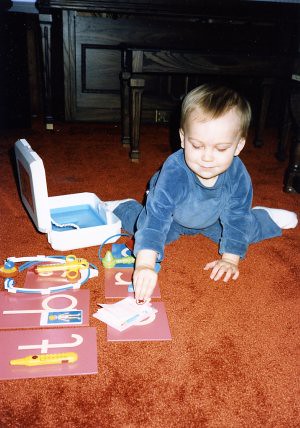
Will (1 1/2) playing the “fun game” with objects from his medical kit in 1986.
Because of Will’s fascination with sandpaper letters and miniature objects, I used an extension to learning phonetic sounds that Will named the “fun game.” I placed sandpaper letters one at a time on the floor (at the school, we placed the letters on a rug).
I said the letter’s phonetic sound and let Will put the matching object on the sandpaper letter. Often, Will traced the sandpaper letter first. I might emphasize the object’s initial sound by saying something like, “Can you find the zzzebra?”
We gradually added more objects for each sound. Will loved the game so much that we even took the sandpaper letters home during the weekends.
Normally, I wouldn’t introduce sandpaper letters at such a young age. I just followed Will’s interest. He found the “fun game” so interesting that he knew all his phonetic sounds at age 1½.
So, what does that say? I think it says a couple of things.
1. The most important part of Montessori education is Maria Montessori’s message to observe and follow the child’s lead.
The teacher must derive not only the capacity, but the desire, to observe natural phenomena. In our system, she must become a passive, much more than an active, influence, and her passivity shall be composed of anxious scientific curiosity and of absolute respect for the phenomenon which she wishes to observe. The teacher must understand and feel her position of observer: the activity must lie in the phenomenon.
There was no method to be seen, what was seen was a child…acting according to its own nature. The essential thing is to arouse such an interest that it engages the child’s whole personality.
One test of the correctness of educational procedure is the happiness of the child.
And, so, we sometimes just need to put aside our preconceived notions and follow the child.
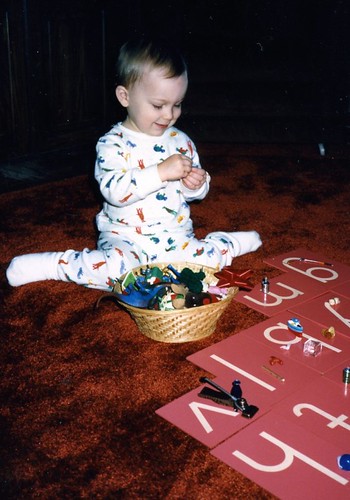
Will playing the “fun game,” 1986
2. The “fun game” is a good extension of the sandpaper letters and a way for young children to enjoy learning phonetic sounds.
Of course, the activity might be best at age 3½-4½. But you as the parent know your child and can tell when your child is ready. If you introduce the activity and your child isn’t interested, wait and introduce it later. Or find a way to introduce phonetic sounds that interests your child.
Once your child knows the phonetic sounds, the task of learning to read is so much easier. Later, your child will just need to learn to blend sounds to be able to read simple words.
So, go ahead and trust yourself. Trust your child. Learning to read can be just a fun game.
Some helpful links:
How to introduce sandpaper letters, including a video on introducing sandpaper letters: How to Teach Concepts and Vocabulary to Your Preschooler Using the Three-Period Lesson.
I have a post with video on how to pronounce the phonetic sound for each letter: Teach Letter Sounds to Your Child Using Montessori Principles.
Disclosure: Contains some affiliate links at no cost to you.
To Buy or Make Your Own Sandpaper Letters:
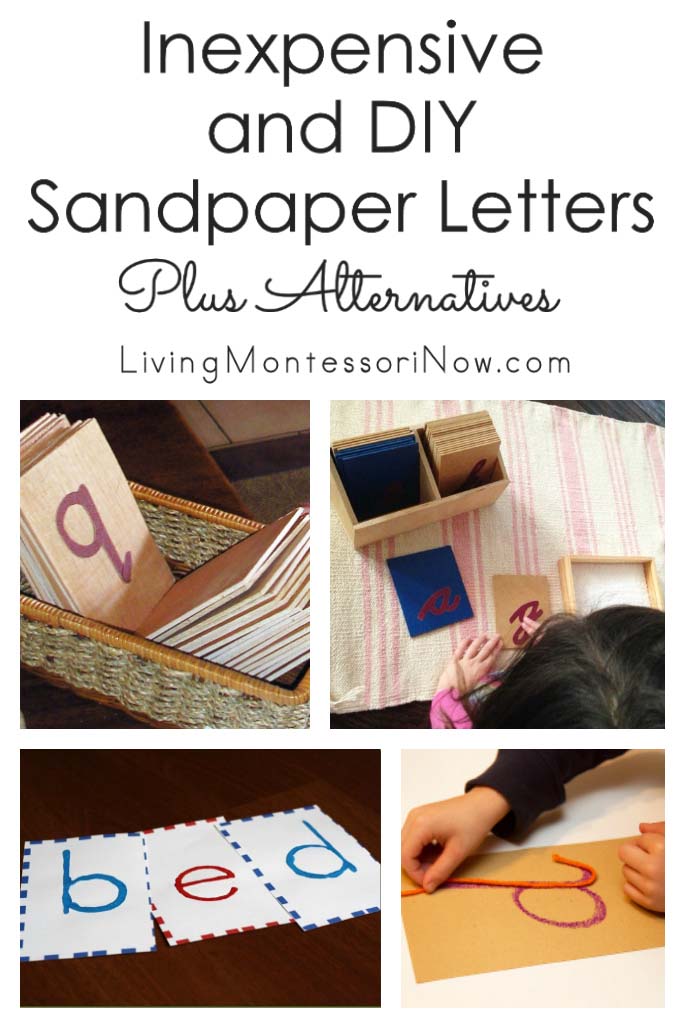
Update: I have a roundup post with lots of resources for DIY sandpaper letters as well as places to buy inexpensive sandpaper letters.
Places to buy small objects:
Craft stores typically have lots of small objects that work well. Miniature toys, such as Barbie accessories, are also good sources.
Although often more expensive, you can buy objects specifically for sound sorting. Here are some examples:
Montessori Services
Other sound-sorting activities:
Momtessori has another variation of the sound sorting activity: Sound sorting.
Momtessori also has another variation with the I spy game: I spy with my little eye …

Update: You’ll find more helpful resources in my post with favorite phonics materials for preschoolers.
Note: If you wondered about my son’s W-sitting, we hadn’t heard about it back when he was a toddler. Later on, when Will had to take ballet for figure skating, his ballet teacher told him W-sitting wasn’t good. So he stopped. He went on to become an elite athlete. 🙂

 Learn more about my eBook Montessori at Home or School: How to. Teach Grace and Courtesy!
If this is your first time visiting Living Montessori Now, welcome! If you haven’t already, please join us on our Living Montessori Now Facebook page where you’ll find a Free Printable of the Day and lots of inspiration and ideas for parenting and teaching! And please follow me on Pinterest (lots of Montessori-, holiday-, and theme-related boards), Instagram, and YouTube. You can find me on bloglovin’ and Twitter, too.
And don’t forget one of the best ways to follow me by signing up for my weekly newsletter. You’ll receive some awesome freebies in the process!







Thanks for sharing this post. My daughter started showing interest in letter sounds about the same age as your son, and she was “reading” before she turned three. Because of her early interest, I’ve tried to “formalize” her education early, but once I formalized it, she lost interest. Keeping it “fun” and letting her set the pace has been the key to helping her learn.
Great point, Ashley! Will was the same way. Keeping the learning fun and child-led (and hands-on as much as possible) was so important for him as well.
Immy has a wooden alphabet puzzle and we have always verbally related the initial letter sounds to the names of people we know or toys she has. It amazes me how easily she has retained the information. Thank you for the links, I will definitely be looking into the sandpaper letters a little further.
Thanks for your comment, Christie! What you’re doing with your daughter is awesome – she’s learning the letter sounds so naturally!
I have never been to a Montessori school before, only studied her ideas as to learning. I do love the idea of following the child's lead and it is something that all early childhood educators should be doing, if they are not already.
Coming through Macquarie University, Reggio Emilia is more looked at as the way of teaching. But for me, I believe that there is no one way of teaching and love looking at different theorists and some of the greats that made early education what it is today {i.e. Froebel, Montessori, Malaguzzi}.
Great article and I think I may have to look at getting some of these letters!
Thanks, Miss Carly! Reggio Emilia has a lot to offer, too. I enjoyed studying the approach during my master’s program.
I have never heard of sandpaper letters!!! They sound like a wonderful learning aid and I will certainly be checking them out now. Thank you 🙂
Thanks for your comment, Monique! Glad I could help!
I agree it's so wonderful to have letters available for children to explore and play with. They see letters in children's books and all around them, but to be able to hold the letters gives an added interest and dimension to their phoenics learning. I completely agree that children are able to learn letter sounds before age two. A fun game we play with fridge magnetic letters is to find the capital and lower case letter matches as we repeat the letter sounds…or…"What says K?" and then your child can bring you the K magnet from the fridge. Like you said, "games" are fun for kids!
Thank you for your comment! And your idea is a great way to use magnetic letters!
Thanks for all the great links! One of my 3 children who have entered school went to a Montessori preschool. We moved and no longer had a centre that was close to get to. I loved the approach and as a parent learned so much from his wonderful teacher. I try to implement parts at home that I can, so your resources will be fab for me!
Thanks for your comment! I love that so much of Montessori education can be used at home. And sharing ways to use Montessori at home is one of my favorite things to do!
This is an awesome post! THank you for sharing. I always did a lot of tactile activities with the kids I used to teach so this has given me lots of ideas. I will definately be doing the sandpaper letters with my kids. Following on from the tactile thing, I used to make up alphabet books with the kids I taught, we'd have a page with each letter and then we'd decorate the letter with something beginning with that letter, eg: B = beads, R = rice and so on. It was lots of fun and I think the kids learnt more by doing it that way (particularly because they were often physically impaired in some way and lacking sensory input)
I love the whole philosophy behind Montessori and that kids can go at their own pace and incorporate their own interests.
Thanks so much, Narelle! And I love your tactile alphabet book idea!
What a bright little boy your son was! I definitely love the idea of following your child's lead. I confess I find this harder to do with my son than my daughter. My daughter and I seem to have a similar way of thinking and her type of intelligence (verbal/ language) is more aligned with what I am like. Although my son is only 1, he is much less verbal than my daughter was at the same age, and prefers visual tasks/ puzzles, matching shapes etc – all things I have no interest or talent for!
Thanks, Julie! I’ve always loved studying learning styles and the Myers-Briggs personality inventory. It is definitely more challenging to meet the needs of children who function differently than we do. My husband, children, and I all have the same verbal/language sort of intelligence, which made it easy at home. With many children I taught, I found Montessori methods and concrete materials really helped me meet the children’s needs even if their learning styles were much different from mine.
I love how Montessori learning emphasizes textures so well. I need to learn how to integrate touch more into our days.
As for learning to read, I know I had some misgivings when my son began to be very interested in letters, sounds, and spelling at age 2. I didn't want to be the "pushy" parent who coerced her precious prodigy into reading before he was ready. But he just loved learning so much — how could I not throw out my caution and just follow his lead in this new play he had discovered, play with words? So we have wooden alphabet puzzles, and we draw letters with chalk, and we point out words on signs, and he eats it up. It's fun to have a child show you that learning doesn't have to be a chore!
Maria Montessori was really brilliant with sensorial education, wasn’t she?! I can definitely relate to your experiences with your son! I had to wonder if I was doing the right thing to step out of the normal Montessori progression even. Yet, in the end, following your child’s interests really can’t go wrong. Thanks for your comment, Lauren, and have fun following your son’s lead!
I wrote a post for Excellence in Early Childhood Education about the Montessori Method as it pertained to infants and toddlers. I just find it fascinating at that age to be able to see their neural pathways develop – literally in front of your eyes. Good post. Cheers, Colin
Thanks, Colin! I find that fascinating as well. I really enjoyed the YouTube video of Dr. Steve Hughes talking about neuroscience and Montessori. I ended up putting the video in a post about the future of education.
I completely agree about the importance of following your child's interests when it comes to learning. And of course, it is important for children to learn the names and sounds associated with each letter.
Thanks for your comment, Catherine! Following the child’s lead and using Montessori methods made teaching reading so easy that I hardly remember the whole experience of my children learning to read. Certain parts, like the “fun game,” really stood out, though.
I think the point about following the child's lead is so important. Most of the parents I know do this, it is instinctive and provides fun for everyone involved. The children learn without really being aware of it, they are just doing something that they enjoy.
I love the sandpaper letters. Is it the textural element of the letters that add to the child's enjoyment of them? I think when there is an extra element, such as touch, it makes the activity more interesting and engaging for the child.
I will have to look up some of those other activities for Princess, I think 🙂
Lovely post 🙂
Thanks for your comment! Yes, I definitely agree that young children respond to the sensorial element of sandpaper letters. Not only does tracing the letters prepare them for writing but learning by doing/learning through the senses is the natural way for them to learn.
Thank you for your kind words, Mari-An. I really enjoyed finding great resources like your Counting Coconuts posts.
This is a very informative and helpful post – so good of you to compile it all in one place!
Warmly,
Mari-Ann
Counting Coconuts
This sounds like it would be a perfect activity for my youngest who has just started showing an interest, indeed a real desire to match letters with sounds. Although I'm not a homeschooler or a practiser of Montessori methods I absolutely agree that taking the child's lead is so important. What I find hard about putting that into practise is the flexibility it requires – if I've planned something it may have to go out the window and I find that very hard to deal with sometimes if I'm honest!
Thanks for your comment, Zoe! That’s a good point about the flexibility required in following a child’s lead. It’s fortunate that the results make it all worthwhile.
Very informative! Thanks for sharing!
Thanks for your comment, Kerri! I had fun remembering when Will was little and finding the links.