
Here are my top 10 Montessori principles that can be used whether or not you own traditional Montessori materials. These principles are relevant for any preschooler. To me, they fit with natural learning because they meet young children’s natural needs without requiring a specific material.
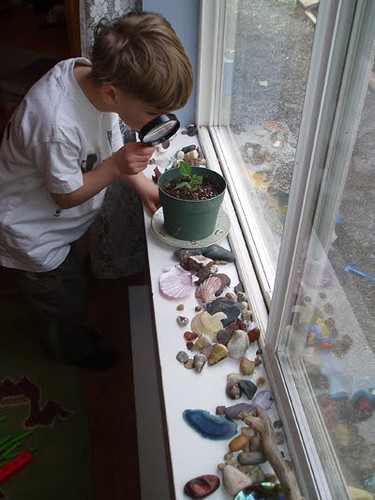
A windowsill converted into a nature table. (Photo from The Montessori Child at Home)
1. Follow the child. The. Most. Important. Principle. For any age.
Individualize learning for your unique child’s needs and interests. In Montessori, this is done by observing your child to see what your child’s needs and interests are and by respecting – honoring – those needs and interests.
2. Respect and encourage your child’s absorbent mind and sensitive periods.
3. Allow your child the freedom to explore indoors and outdoors – as long as your child is safe and using the freedom in a positive manner.
Independence and self-directed learning are important concepts/goals of Montessori education.
4. Give your child as many opportunities for hands-on learning as possible.
It’s important that your preschooler has concrete, hands-on experiences before learning abstract concepts.
5. Emphasize practical life and sensorial activities in the preschool years.
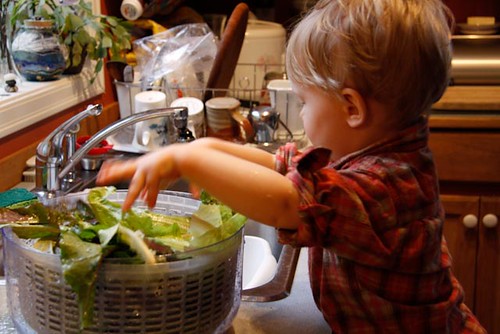
Washing salad greens for the family’s dinner. (Photo from The Montessori Child at Home)
Practical life activities for care of self, care of the environment, control of movement, and grace and courtesy help your child develop order, concentration, coordination, and independence. Activities to refine the senses give indirect preparation for later academic learning.
6. Provide child-size materials (and real child-size tools) wherever possible.
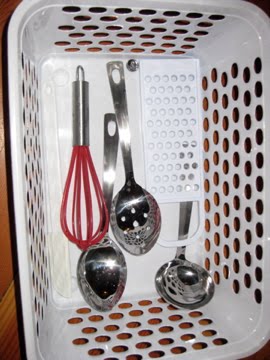
Basket of child-size utensils kept in the kitchen for a child to help prepare dinner. (Photo from The Montessori Child at Home)
Place materials on trays on low shelves, allowing your child the opportunity to choose his or her own work and to repeat activities as often as needed.
7. Don’t interrupt your child’s work cycle. Let your child develop an ever-increasing ability to concentrate.
Competition, tests, rewards, and punishments aren’t necessary. Your child will develop a sense of satisfaction over work well done.
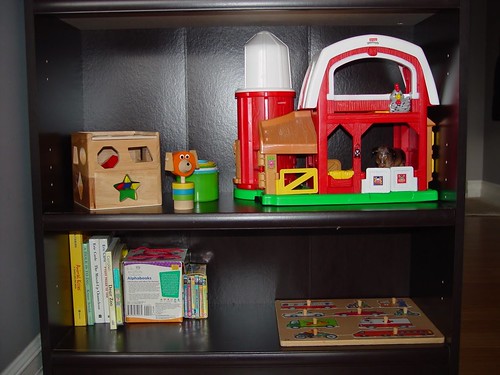
Child’s toys neatly arranged on low shelves in the family’s living room. (Photo from The Montessori Child at Home)
8. Make your child’s environment as orderly and attractive as possible.
An orderly environment assists your child in developing mental order and intelligence.
9. Demonstrate how to do an activity.
Don’t expect your child to automatically know how to do something or to know the appropriate behavior without having it demonstrated first.
10. When you offer an activity, check that one quality is isolated (for example, it helps if only the color – and not the shape – varies if you’re introducing your child to colors), and there is a control of error (instant feedback built into the activity) whenever possible.
If you follow Montessori principles, you will help your child naturally develop many positive skills and traits that provide a strong foundation in life – skills and traits such as independence, self-discipline, and love of learning.
UPDATE: To take the next step, please read How to Start Using Montessori at Home.
Photo Credits: Thank you to the families who have so kindly shared ways they apply Montessori principles in their homes through Cynthia Dyer/The Montessori Child at Home.
How have you observed Montessori principles at work in your child’s life?

If this is your first time visiting Living Montessori Now, welcome! If you haven’t already, please join us on our Living Montessori Now Facebook page where you’ll find a Free Printable of the Day and lots of inspiration and ideas for parenting and teaching! And please follow me on Instagram, Pinterest (lots of Montessori-, holiday-, and theme-related boards), and YouTube. While you’re here, please check out the Living Montessori Now shop.
And don’t forget one of the best ways to follow me by signing up for my weekly newsletter. You’ll receive some awesome freebies in the process!








“It’s important that your preschooler has concrete, hands-on
experiences before learning abstract concepts.” What an incredible way to say this, I’d never thought of it in these terms. When Kieran was much younger, Tom would tease me about taking him places (not my ordinary places, but special things – classes, outings, etc.). He’d say “but he won’t remember anything!” And I said, “but he’s still getting something out of every experience.” I wish I’d had this phrase in my pocket 🙂
Thanks so much for your kind comment, Dionna! How great that you’re giving Kieran so many hands-on experiences! It’s so true that young children pick up much more from experiences than we realize.
These principles are why I so admire the Montessori method. It gives children such confidence and determination to forge their own path in this world!
Thanks, Kyle! So true!
I was lucky enough to get to go to Montessori when I was a kid, and I’ve looked longingly at the schools around here, but they are drastically out of our price range. Thanks for the reminder that we can incorporate these principles into our own homes even when the school experience is out of reach.
It’s great that you were able to attend a Montessori school as a child, Seonaid! Isn’t it fantastic that there’s so much you can do with Montessori principles at home?!! My daughter’s whole Montessori (and schooling until college) was at home, and none of us have any regrets!
Deb – love this post! To add to #6, even if you don’t have child sized tools and materials – the key thing for me is REAL materials. Kids don’t need pretend materials, they are completely capable of working with real materials and tools, with the obvious safety and supervision of course.
Thanks so much for your comment, Shannon! I love the Montessori emphasis on using real tools and materials. It’s interesting that when I had a Montessori school where the children were free to use a real (child-sized) hammer, nails, and saw, no one got hurt – and the children had so much pride in their woodworking skills!
Learning to read is another area where parent modeling and facilitating is essential. Providing appropriate guidance, discussion, connections to their understanding as well as choice is essential to the process.
Visit Stepping Stones Together at http://www.steppingstonestogether.com to learn more about pre-emergent reading which helps facilitate a love and commitment to a lifetime of learning and reading.
Thanks for your comment, Erika! That’s so true. I love that you have parents commit to spending time helping their children learn to read.
What a great post. I went to Montesorri school when I was younger, and would like to pull in some of the philosophies into our home, even though we don’t homeschool, we do a lot of learning activities, and would like our home to be full of learning opportunities. Thanks for this post, it gave me some really concrete ideas of where we can start!
Thanks so much, Jackie! I really love that Montessori principles can be used at home regardless of your child’s experiences outside the home. It’s awesome that you’re so actively involved – and it’s great that you have a Montessori background yourself!
Thanks for all of the great information!
Thanks for your kind comment, Holly!
Thanks for a great summary of Montessori! We’ve been working on some of these without really realizing that they are Montessori principles – just kind of naturally drifting towards kid-sized tools, working harder to keep our space orderly, letting the kids determine how long they want to work on something and following the child’s lead with interests and needs. I’m looking forward to reading more about the sensitive periods!
Thanks, Michelle! It’s awesome that you’re naturally using Montessori principles – well done!
Thanks for sharing this information.My baby is just 20 months old and i don’t send him to any Montessori. but i give him freedom to do any thing at home, he is interested in playing with vessels, whenever i am in the kitchen he sits on the platform and plays with ….. and enjoys, and when he is in other rooms he enjoy playing with his toys. He has not yet started talking, only 4-5 words, but he will be talking in his own language and understand whatever i say to him and i don’t force him to do any thing or learn any thing, i think that once we send them to Montessori or any school and start learning there is no end to that, so for the time being let him do what he want and enjoy. I don’t know i am correct or wrong. but this is my thinking.
Thanks for your comment! Spending time with your baby and giving him freedom to safely explore is definitely most important. It sounds like you’re doing a great job!
Thank you for putting these so concisely! It is very helpful and seems so much more do-able this way!
Lori
http://www.beneaththerowantree.com
Come & Join the Playdate!
Thanks, Lori! I’m so glad you found it helpful!
Thanks, Lori! I so glad it’s helpful!
I love that you gave people a starting point to discover Montessori. I enjoyed your post so much that I featured it here:
http://mymontessorimoments.wordpress.com/2011/03/08/first-day-in-our-new-room/
I hope it spreads the joy that Montessori can bring. 🙂
Thanks so much for your very kind comment, Lori! And thanks for featuring my post – I’m truly honored! 🙂
I’ve always been curious about what Montessori is all about. This is a great list.
It’s very much what I like about Waldorf.
Thank you.
Thanks, Teresa! Montessori and Waldorf do have a lot in common (and a lot of families follow principles from both Montessori and Waldorf)!
Thank you very much. I have been eager to learn more about alternative schooling, and this is just what I need. We are unschoolers, but I like to read about early childhood education anyway.
Tweeting this and will be using inSunday Surf
cheers
Thanks so much! I loved using Montessori principles, especially since so many of them could be applied all through my kids’ childhoods (and some like “follow the child” work when they’re adults)! Thanks for tweeting this and using it in Sunday Surf!
What a great list! I’m still learning about Montessori principles but I love that the overall theme is respect for the individual child. Thanks for sharing!
Thanks, Brittany! I love the emphasis on respect as well – and it’s great that it can be applied all the way through adulthood.
Fabulous post Deb!! Good reminder on the sensitive periods.
Thanks!
Kerri
Thank you, Kerri! I’m so happy you found it helpful!
These sound wonderful. I would really like to learn more about Montessori and start using it, now that my son is (how did this happen?!) changing into a toddler all of a sudden.
Thanks so much, Sheila! Yeah, where do those babies go so suddenly??! This would be a great time to start using Montessori principles!
What I like about these principles is that I can apply them to my 1-year-old as well. We try to keep an orderly space, but have become a bit more lax lately, this inspired me to weed out some toys in her main play spaces today – thanks!!!
Thanks, Andrea! I’m so happy I could help out! 😉
These are great principles. I think I’m going to make a list and post them somewhere I’ll see everyday so I get better at applying them. Thanks!
Thanks, Michelle! That’s great – love to hear it!
I love these principles, and keep coming back to digest them further. I’ve been working on a few of them specifically lately: creating order, encouraging independence, and demonstrating activities first. It’s amazing how well even simple changes can help, if you’re willing to try. I like the point of not interrupting your child’s work cycle. I really appreciate that idea of letting kids concentrate as long as they need to on a project.
Thanks, Lauren! It’s great to hear how you’re using Montessori principles at home! It really is amazing how much difference using even a few of the principles can make.
Wonderful post. I love the pics and now I can tell the child in the first pic that I know a famous person!!
Thanks so much! It’s amazing that you know the child in the picture – fun!